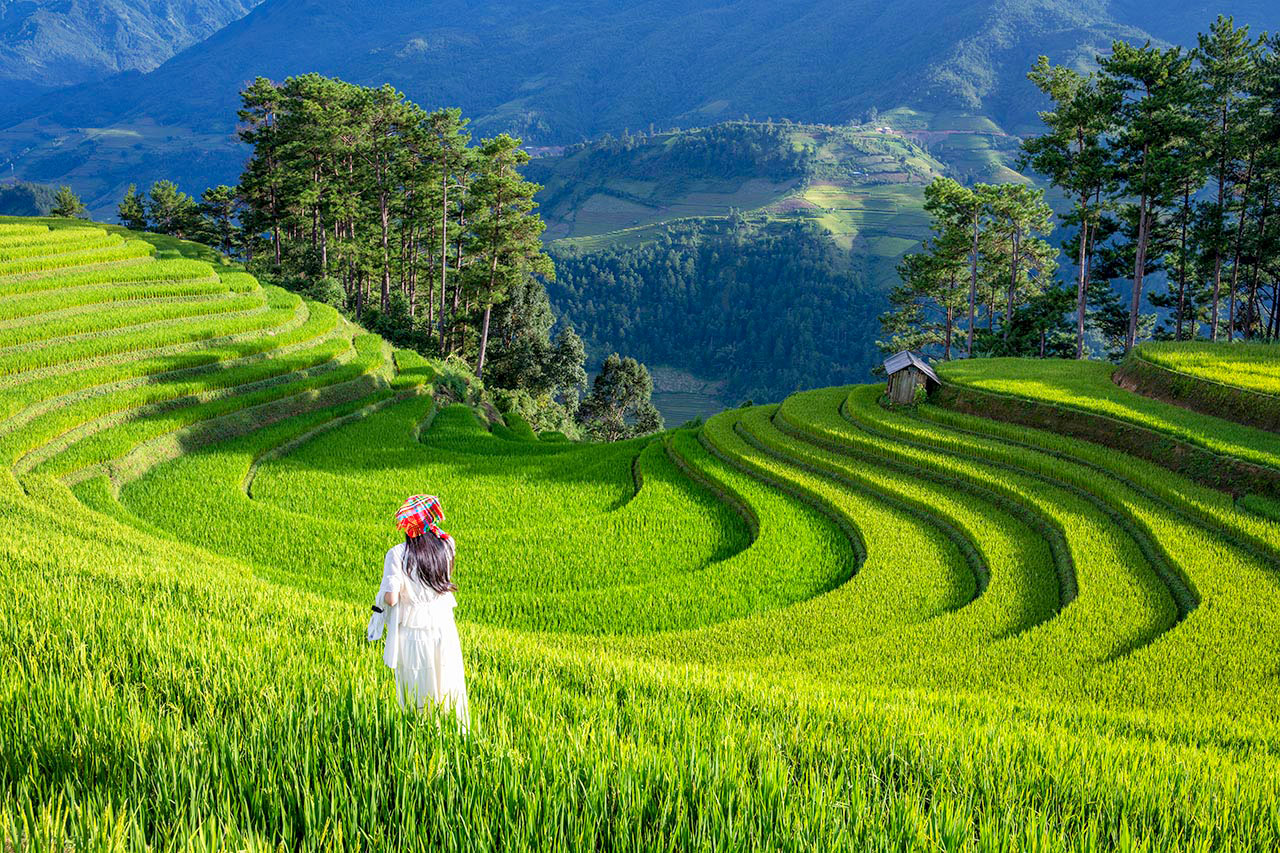
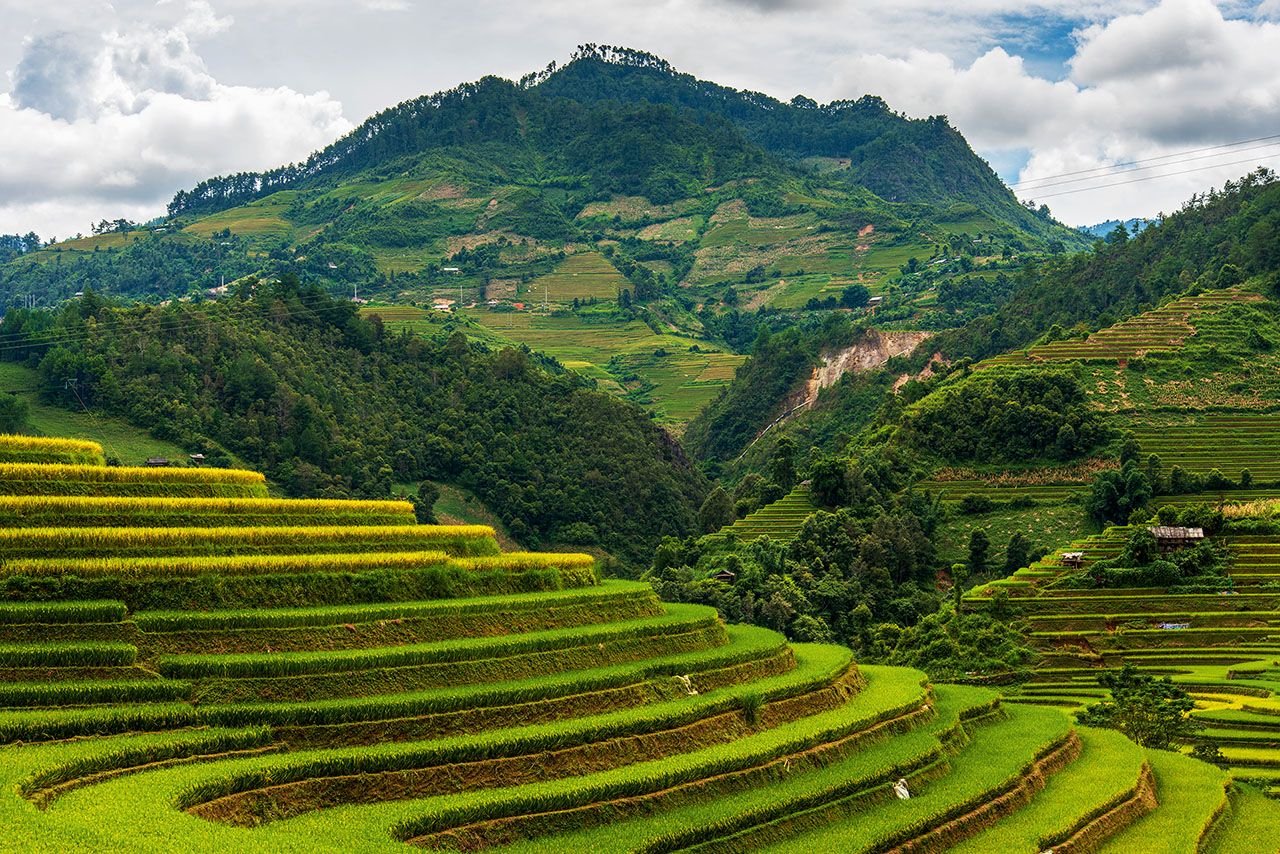
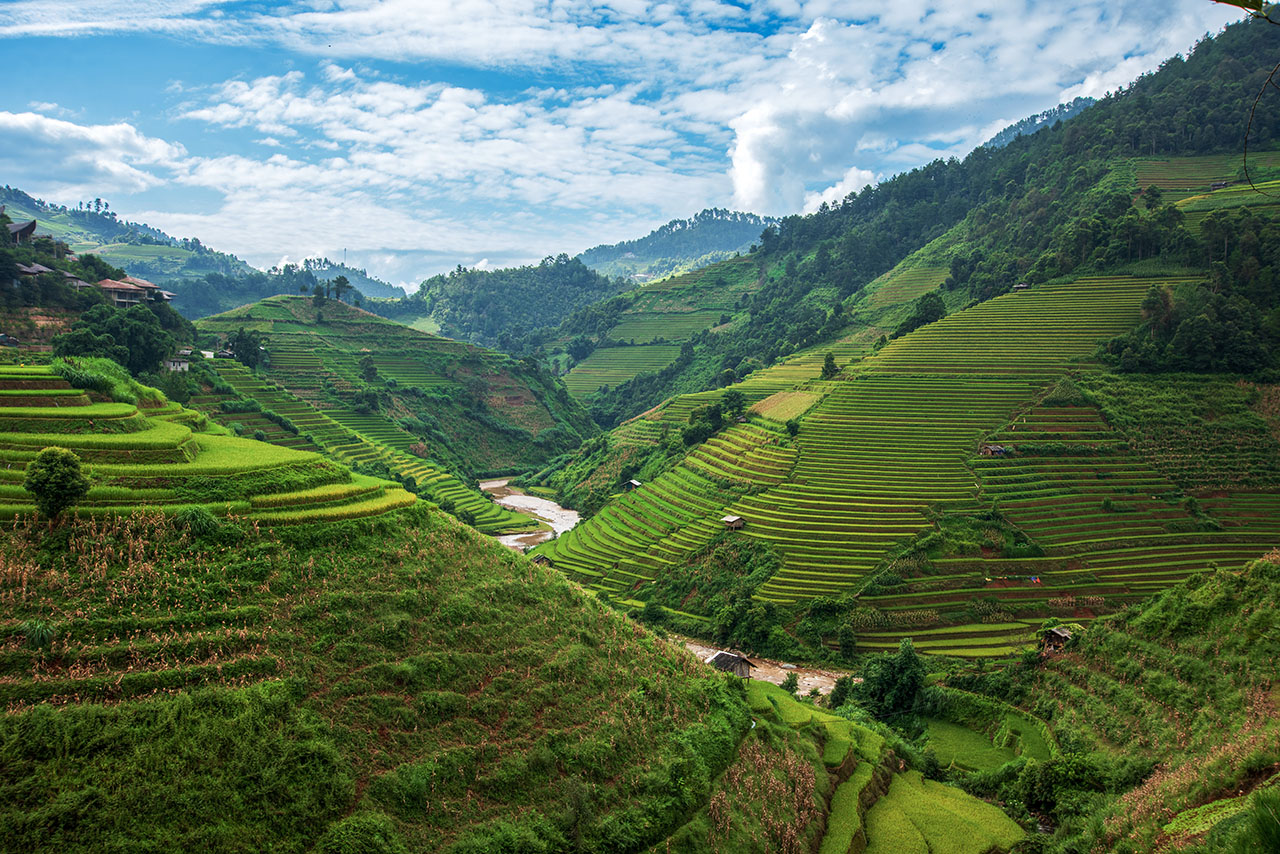
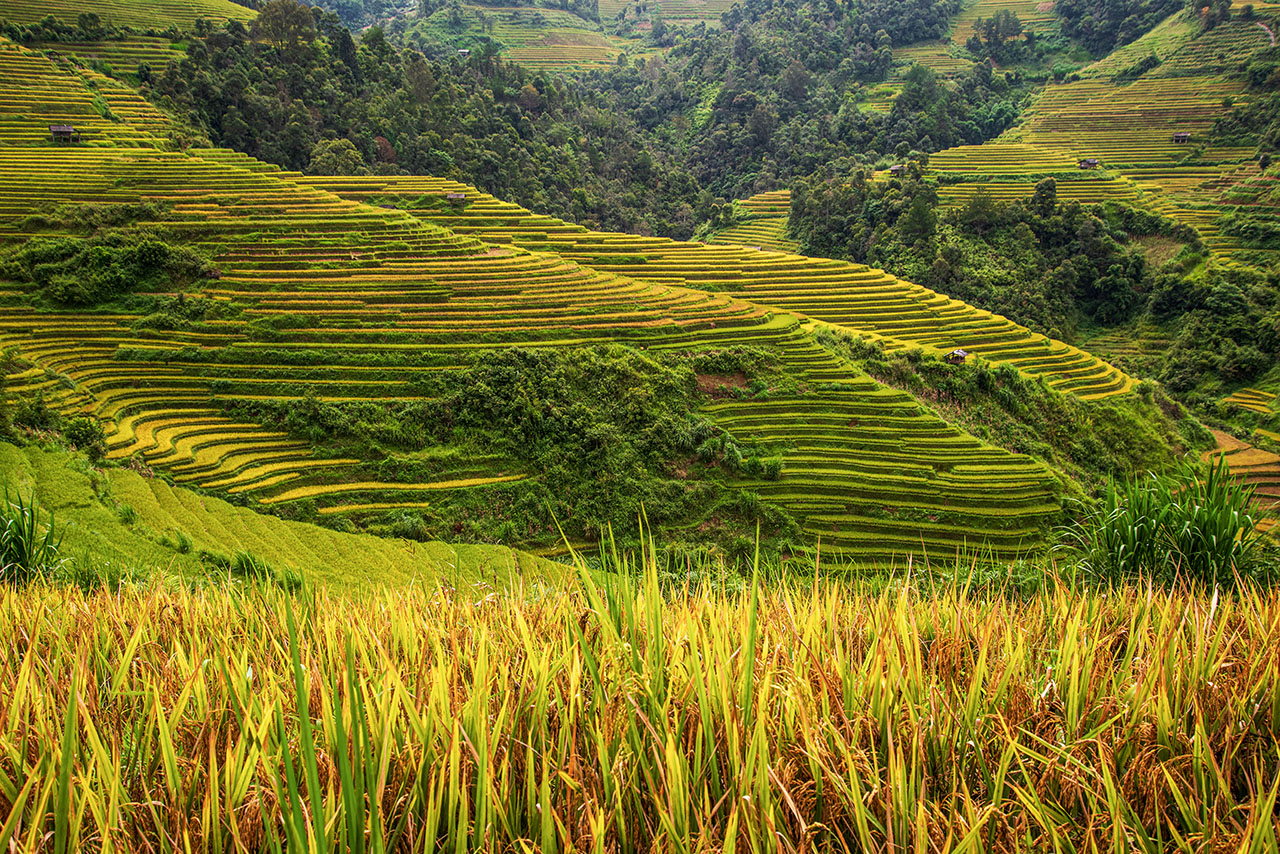
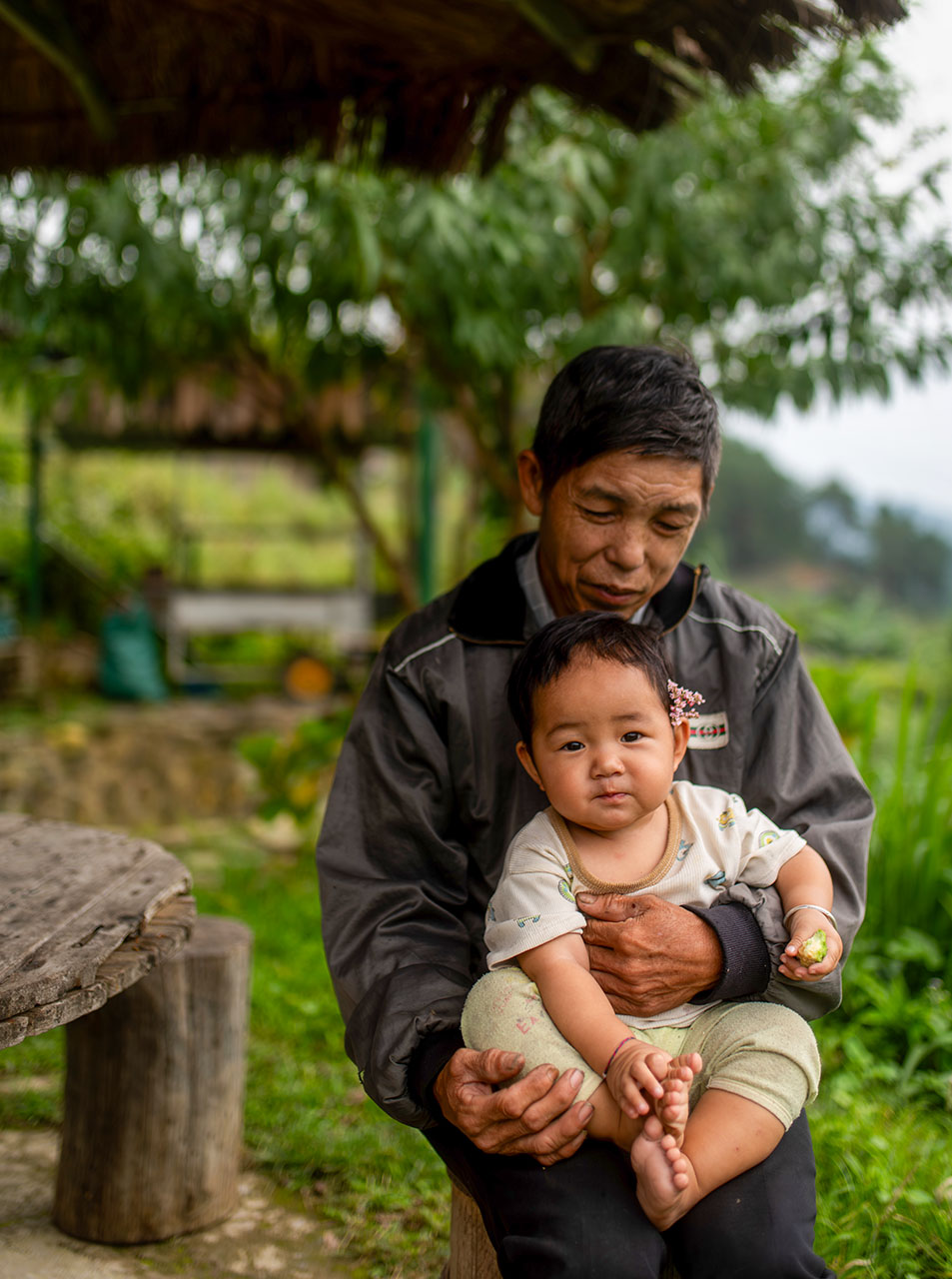
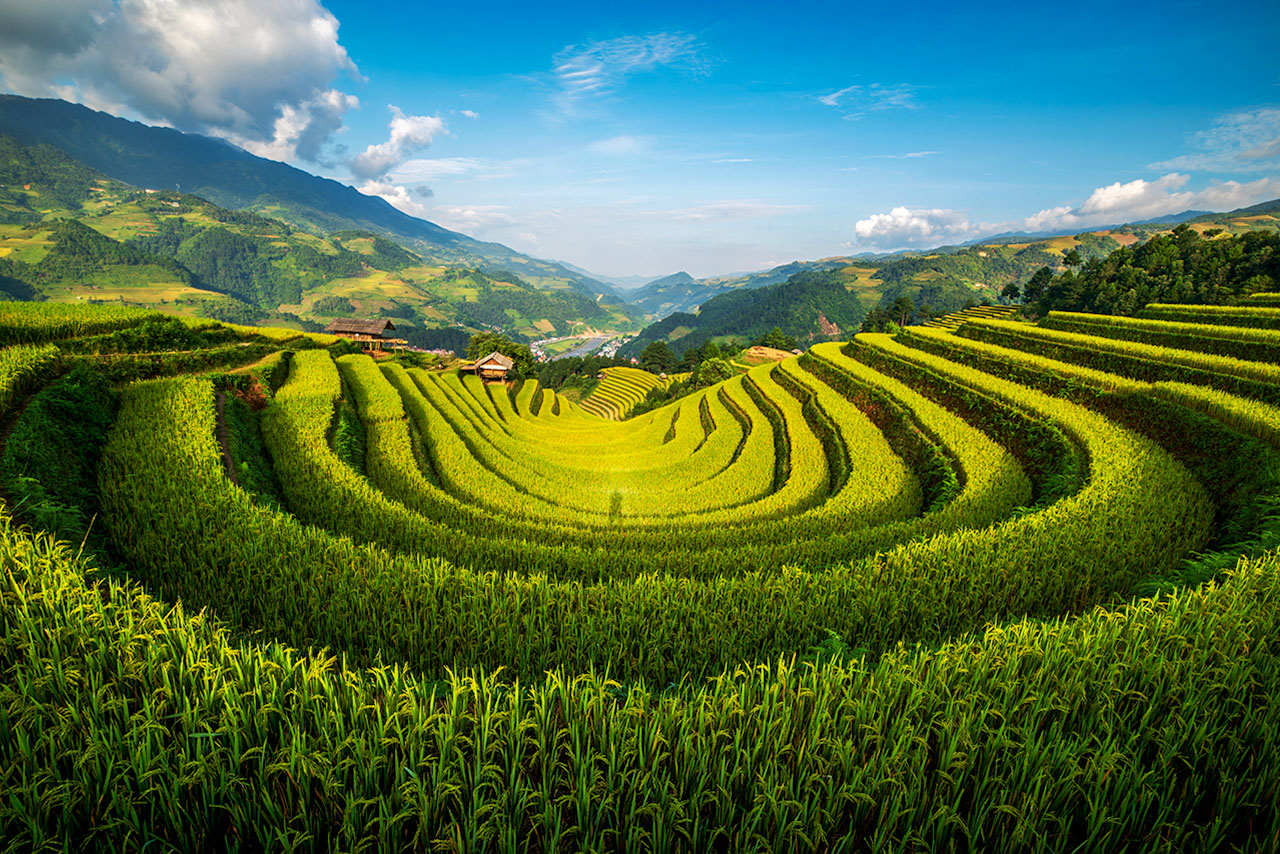
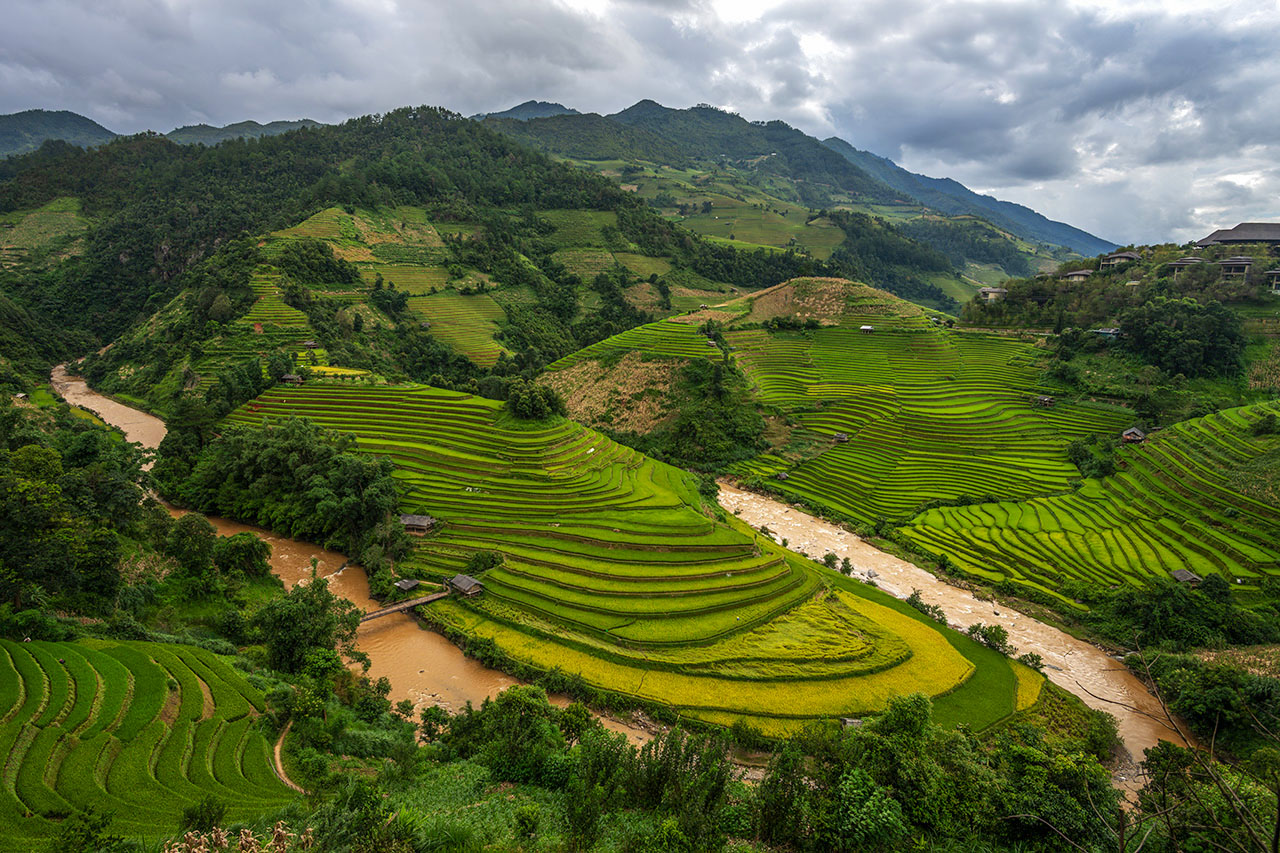
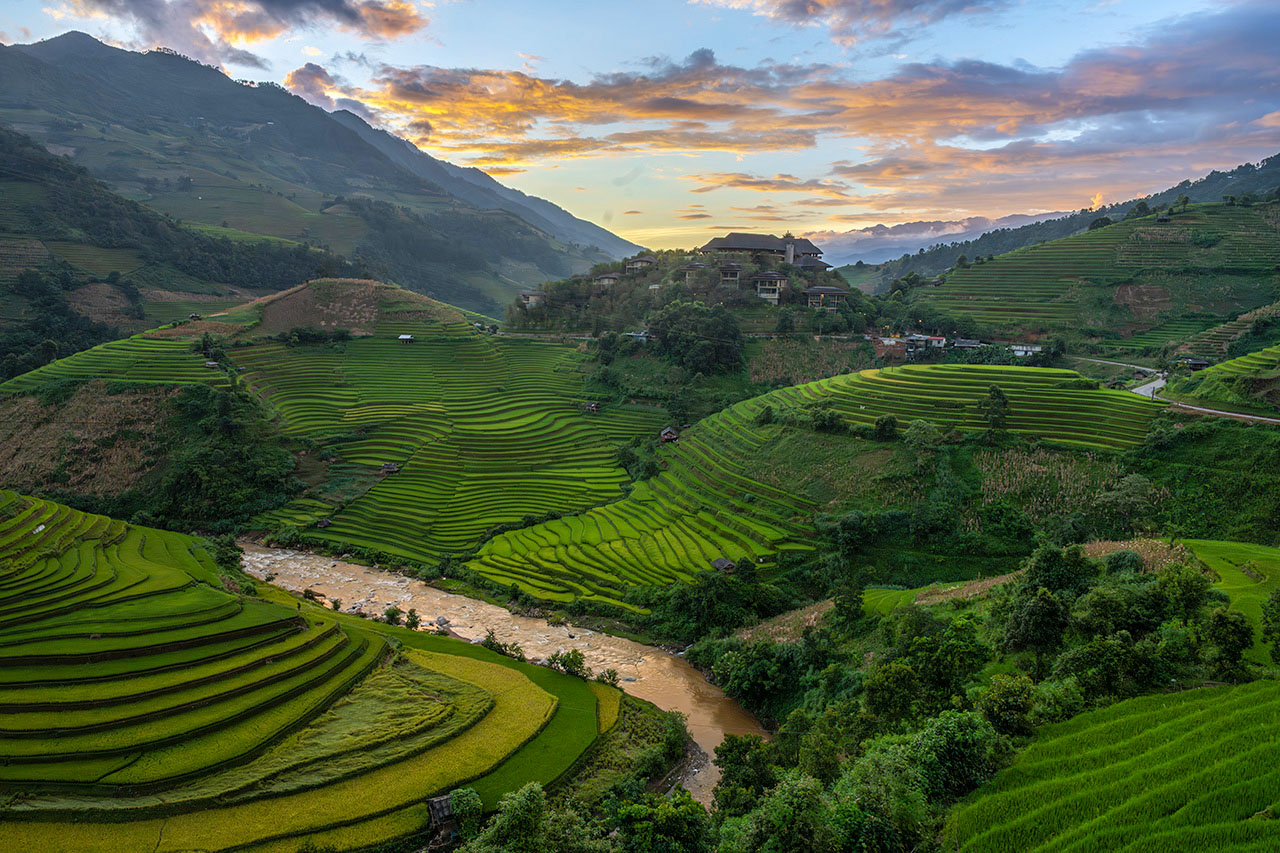
When you see photographs of Vietnam’s spectacular terraced rice fields, there’s a good chance they were taken in Mu Cang Chai. The area contains some of the country’s most iconic rice terraces, along with Hmong villages and homestays that provide excellent opportunities for landscape, travel, and people photography. The main rice fields extend along about a 20 km-stretch of Rt. 32. From south to north they include:
- Pung Luong and La Pan Tan — Heart of Mu Cang Chai
- Mu Cang Chai Town, Mong Ngua and Kim Noi — Beautiful mountain views
- Lao Chai — Remote and authentic
As you enter Mu Cang Chai after coming over the Khau Pha Pass you will arrive at Pung Luong. This area gets fewer visitors as people head straight to La Pan Tan. The rice is planted a bit earlier here so if you arrive in late May you may get to see the water-pouring and planting and in early September the fields will be golden yellow with workers harvesting the rice. Pung Luong is also home to the Na Hang Tua Bamboo Forest, a large grove of up to 60 year old giant bamboo plants.
The largest community of Hmong families and homestays is in the hills of La Pan Tan. Recognized as a national heritage site, the vast terraces of La Pan Tan covers entire mountain slopes. You can spend days wandering the small roads in the hills on your motorcycle, finding vista after vista. This is also the home of the most iconic terraced rice field, “Mam Xoi.” You also have Mam Xoi Be, or Baby Mam Xoi, and a number of smaller fields. These are very steep, winding, narrow mountain roads. There isn’t a lot of traffic, although the local young people sometimes fly around the corners on their motorcycles.
Between La Pan Tan and Mu Cang Chai town, there are a number of rice fields directly on the highway or just off it. Some of the better-known areas are here, so it can be convenient to stay at one of the homestays on Rt. 32. This includes Mũi Giày the famous shoe-shaped terraced field directly on Rt. 32. A bit further up the road, stop at one of the coffee shops like Loan Phuong Coffee with its balcony jutting over the rice fields for a great photo location, coffee or even a local lunch.
Mu Cang Chai has a small downtown area between La Pan Tan and Lao Chai along the Nam Kim River. There are plenty of small hotels, stores, and local dining spots, mostly simple Pho shops. One of the larger rice fields, Kim Noi can be accessed from just across the river near the center. Kim Noi sits high up in the hills and offers an elevated view of the rice fields with mountains in the background. On the other side of the street in Mu Cang Chai town you access the famous Mong Ngua horseshoe-shaped fields. Mong Ngua is the go-to spot for sunsets in Mu Cang Chai. Get there early, during the prime harvest and water-pouring seasons there will be scores of photographers with tripods staking out the center of the curved rice field for the best composition. Just up the street from Mong Ngua is the bamboo forest. This can be a good place to go when the sun is high and too harsh to photo the rice fields. Move your aperture up to f/16-f/22 and get nice sunstars as the rays peek through the dense bamboo.
About 15 km outside of town heading towards Than Uyen is Lao Chai. This area gets few visitors but has some gorgeous rice fields. Head for the Lao Chai viewpoint on Google Maps. But don’t stop there, another 4-5 km up the mountain is an amazing rice field with glorious sunsets that few people know about.
A number of locations in Mu Cang Chai are serviced by motorcycle taxis from Rt. 32. These include Mam Xoi, Mong Ngua, and the bamboo forest. The access roads to all three sites are extremely steep. Inexperienced riders, particularly those on automatic scooters or motorcycles poorly suited to steep mountain roads, should consider using the inexpensive local motorcycle taxis.
Getting to Mu Cang Chai
Getting to Mu Cang Chai is not difficult, but it can be time-consuming. There are bus options from Hanoi, but these are typically over 8 hours. Daytime and overnight buses operate from Hanoi, with journeys typically taking around eight hours. Overnight buses can arrive very early in the morning, which isn’t ideal for photographers checking into accommodation. There is typically a bus leaving My Dinh Bus Station at 8:45 am arriving at 4:30 pm. Look for The Anh bus service online or go to the station if you are in Hanoi. Check current schedules before traveling. A private car can easily get you from Hanoi to Mu Cang Chai in just over 6 hours. You can also stop in Tu Le and the Khau Pha Pass on the way for a few photos. If you are not traveling alone and can share the fare, this is the best option with prices as low as $175 each way.
Of course, I think the best way is by motorcycle. It is 290 km, so a bit over my daily limit of 250 km. I tend to stop in Tu Le, which is a lovely rice-growing area just on the other side of the Khau Pha mountain pass before Mu Cang Chai. But if you get a really early start and take a couple of nice breaks, the ride is manageable in one day.
Photography Tips
I try to keep my gear for Mu Cang Chai and the mountains in general fairly light, just one body
Kit:
- 14mm f/2.8 — I usually pack this but only bring to the field on the days I think I’ll need it.
- 20 mm f/1.8 — good for rice terraces and milky way
- 24-120 f/4 — great all around lens the extra reach over a 24-70 is great andI am usually at f/5.–8
- portrait lens — If travelling light 85mm f/1.8. If I know I want a focus on portraits or a lot of market days 135 f/1.8
- telephoto — I usually leave the 100-400 at home and travel with a variable aperture medium tele.
- DJI Osmo and GoPro with nd filters
- misc — ND filter for waterfalls, polarizer for reflective surfaces, sensor and other cleaning kit, spare memory cards, card reader, spare batteries.
- lightweight tripod
Drone photography
Mu Cang Chai is spectacular from the air, but Vietnam’s drone regulations have changed considerably. Don’t assume that a small drone can simply be launched over the terraces. Check current restrictions and permit requirements before traveling; see my updated Drone Laws in Vietnam for Photographers guide.
Best Time to Visit
Mu Cang Chai shares the rice season timing with Hoang Su Phi, a bit later than Sapa. So plan for June as the water-pouring and late September to early October as the prime golden harvest time. he timing isn’t identical throughout Mu Cang Chai. Pung Luong tends to run somewhat earlier than the main terraces around La Pan Tan, so photographers visiting at the edges of the season may find substantially different conditions within a relatively short distance. Mu Cang Chai is quite popular, particularly at harvest time. Be sure to book bus tickets and accommodations in advance, particularly on the weekends.
Mu Cang Chai is the home of the most iconic terraced rice fields in Vietnam. If you want to capture these golden staircases and local Hmong culture it is a must-see in Vietnam for a photographer.
Home » Northern Vietnam » Mu Cang Chai